
By O. Z. Kartal
In May of 2023, I started going to the bathroom a lot. Many times a day, I would make the pilgrimage to the bathroom, sit on the toilet, and try everything to push down the liquids filling up inside me.
Nothing would come out.
My mind started to wonder: what was wrong with me? I started thinking of the complex network of structures housed within my body: did I even know what my internal operations consisted of? They seemed so complex, yet they were mine.
“Are you sure you don’t have a UTI?”
My friend Ally was asking me. I was sure; I didn’t have any pain or that burning sensation signalling an infection. It was just that the pee inside my body wouldn’t come out, and I didn’t know how to make it come out. It was like I had forgotten how to pee.
The time of endless trips to the bathroom coincided with an incident. You could call it by any of its names. The kind of incident that struck your mind like a bullet through a body, and restructured your memory–and your entire being.

Who am I and what are the things that have happened to me, and can I think of them?
Can I hold them in my mind long enough, as long as I can hold my pee which is now 6 hours and counting?
I go to the bathroom again,sit on the toilet, and try to focus on the task at hand and fail. A few months ago, I met a guy. He seemed really sweet. Are those facts?
The image of his face quickly floods my brain, and I hold my breath to erase it. My body tenses at the same time.
I leave the bathroom with the imprint of the toilet seat on my butt. Mission failed.
When I first met Karina, one of the occupational therapists working at the physiotherapy office, I was in crisis mode.
I got off at Namur station and walked by the giant orange, holding my pee. I walked into the office, holding my pee, looking at the baby pictures on the walls–pelvic floor physiotherapy was mainly meant for mothers who had just given birth, or so I thought. Another reason to make this so improbable, the failings of my body much more shameful.
I went inside and asked one of the physiotherapists: what is wrong with my body, that I have become incapable of the simplest of actions that should come naturally?
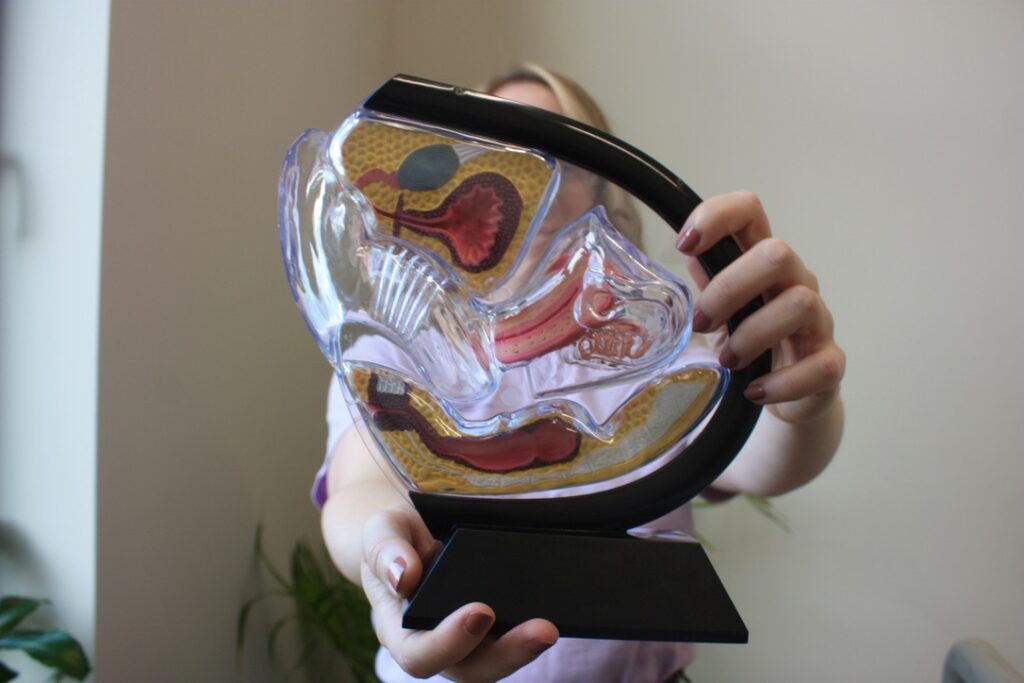
She explained to me all there is to know about the pelvic floor–the group of muscles that control peeing, pooping, intercourse, giving birth–these structures that are housed in our bodies, that are us, that we don’t even talk about. She then explained to me the pressures we can hold in our bodies, and how trauma can be stored physically in the most intimate of places.
Karina Jackson is an Occupational Therapist & Certified Perinatal Mental Health Provider whose specialities include pelvic health, maternal health, hand therapy for mothers and the general population, psychosocial support, and sexuality counseling.
She explains: “I support clients experiencing bladder, bowel, and sexual dysfunction, including incontinence, constipation, pelvic pain, and pain with intimacy. I use education, behavioral strategies, and individualized exercise programs to help clients regulate pelvic floor function, improve daily comfort, and restore participation in meaningful activities. My practice is rooted in trauma-informed care and an awareness of the systemic inequities our clients often face in healthcare. I focus on creating a safe, collaborative space that acknowledges the whole person — body, mind, and lived experience.”
The following is an interview with Karina Jackson.
What are some of the things you wish people knew about the pelvic floor?
I wish more people knew that pelvic health is for everyone. Every person, across the gender spectrum and at every age, has pelvic floor muscles that support organs, continence, and sexual function. Pelvic issues are not limited to pregnancy and postpartum. One of the biggest foundations in pelvic health is breathing. It might sound underwhelming, but breath and connection make a huge difference across so many pelvic floor concerns.
The pelvic floor plays a role in bladder, bowel, and sexual function, but also in everyday stability and movement like walking, lifting groceries, and standing upright. When the pelvic floor is working well, most people don’t notice it at all because these functions happen smoothly and quietly in the background. A healthy pelvic floor depends on much more than muscle strength. Hydration, stress levels, bowel habits, and overall movement patterns all influence how well it functions.
Leaking urine does not automatically mean weakness. It can also be a sign of tension. Pelvic health is not just about Kegels. In fact, Kegels can make some issues worse. And if someone has pain with intercourse, Kegels are rarely the answer. Often the work involves managing stress, building nervous system safety, learning how to relax the pelvic floor, and reconnecting with breath in daily movements. Pelvic health is shaped by culture, our environments, our mental health, our diet, and our physical health.
When should people be coming to pelvic floor therapy?
Prevention is incredibly important and often gets overlooked. I encourage people to come before issues start. We go for check-ups with our doctors, so why not check in with a pelvic health therapist who can assess the internal pelvic floor musculature.
Many of my clients eventually come to me after years of painful intercourse and only realize through a Reddit thread or a TikTok post that pain is not normal. I like to think I am flexible and open to many experiences…..except for this one. Sex should never be painful. Even though pain with sex is very common, it is still a sign that something is going on and the good news is that it is very treatable. If it is your first time, your hundredth time, or somewhere in between, pain should not be brushed off. And if any provider tells you to have a glass of wine and relax, I strongly recommend seeking a second opinion and speaking to a pelvic health therapist.
Pelvic floor therapy is also important after life events such as childbirth or gynecological surgeries, including fibroid removal. Anyone with painful or irregular periods, urinary leakage, chronic constipation, or difficulty emptying their bladder should also be assessed.
There are also subtle signs people tend to miss. If you are that friend who knows every bathroom in the city or the person who must stop multiple times on a road trip to pee, that is worth exploring. I am flexible with what “normal” frequency means, but if someone is going eight, nine, or ten times a day and it disrupts their life, it can signal something deeper.
Being proactive with pelvic health can reduce the severity and duration of symptoms and prevent future issues. Just like strength training protects your joints, targeted pelvic floor exercises (not just Kegels…) and lifestyle support keep the pelvic floor functioning well over time.
What are the most important lessons you offer to the people who come to you?
One of the biggest lessons is that the nervous system is involved much more than people realize. Your nervous system is essentially the boss of your pelvic floor. It decides when the muscles tighten, when they relax, what sensations you perceive, and how the pelvic organs function. When the nervous system is overwhelmed or stuck in protect mode, the pelvic floor naturally becomes tighter or reacts unpredictably.
I remind clients that their bodies are doing the best they can with the information and resources they have at that moment. This is not about blame or “fixing” something broken. Our bodies often try to protect us, even when the strategy is no longer helpful.
A lot of people feel disconnected or frustrated with their bodies because of shame or cultural messages about sex and what bodies are supposed to do. One of my favourite moments in Emily Nagoski’s book Come As You Are is when she quotes Canadian sex researcher Robin Milhausen. She says that we raise girls to be sexually dysfunctional by giving them messages full of fear and shame. Then at eighteen we expect them to suddenly be uninhibited, orgasmic, and confident. It doesn’t make any sense. The reassuring part is that anything we learn, we can unlearn. We can build a relationship with our bodies that is based on understanding rather than judgment.
How are trauma and the pelvic floor connected?
Trauma can show up not only in thoughts and memories but also in the body, especially in the pelvis. The pelvic floor is closely tied to our sense of safety and autonomy. After trauma, the muscles may tighten as a protective response and that tension can remain long after the original event. This tension is not only muscular. It reflects a nervous system that is still on alert. Even when the danger has passed, the body can stay braced. This can lead to persistent pain, discomfort, and difficulty with pelvic functions. Seeing symptoms in this light helps shift the perspective from something that needs to be “fixed” to something that needs to be understood and supported.
How has women’s health been neglected in the medical sphere?
Women’s health has been overlooked in research and clinical care for a long time. Hormones and menstrual cycles were often seen as too complicated, so women were excluded from many trials. This has contributed to misunderstanding, underdiagnosis, and dismissal. Symptoms like painful periods, painful sex, leaking after childbirth, or dryness after menopause have been treated as inevitable rather than as concerns that deserve real medical attention.
Women of colour experience even more gaps due to bias and lack of inclusive research. Many people come to pelvic health therapy only after months or years of being ignored or told their symptoms are normal. The dismissal itself can worsen pelvic symptoms because it increases stress and directly affects the nervous system.
My hope is that the more we speak about women’s health and the social and political context that shapes it, the more empowered women will feel to seek providers who listen, validate their concerns, and take their goals seriously.
Working with a pelvic floor therapist like Karina has been lifechanging for me–and for my pelvic floor. I started to realize how disconnected I was from my own body, and how breath and exercises could help me become aware again.
Everything I learned in pelvic floor therapy and how it has positively impacted my life encouraged me to share this information with others. I encourage you to get more informed and involved with a part of our bodies that is essential to health, and yet doesn’t get talked about often.
And I encourage anyone experiencing problems with peeing to try out pelvic floor physiotherapy.

This article was written by O. Z. Kartal, as part of The Red Pen Collective writing group created by Monthly Dignity.
 EN
EN  FR
FR